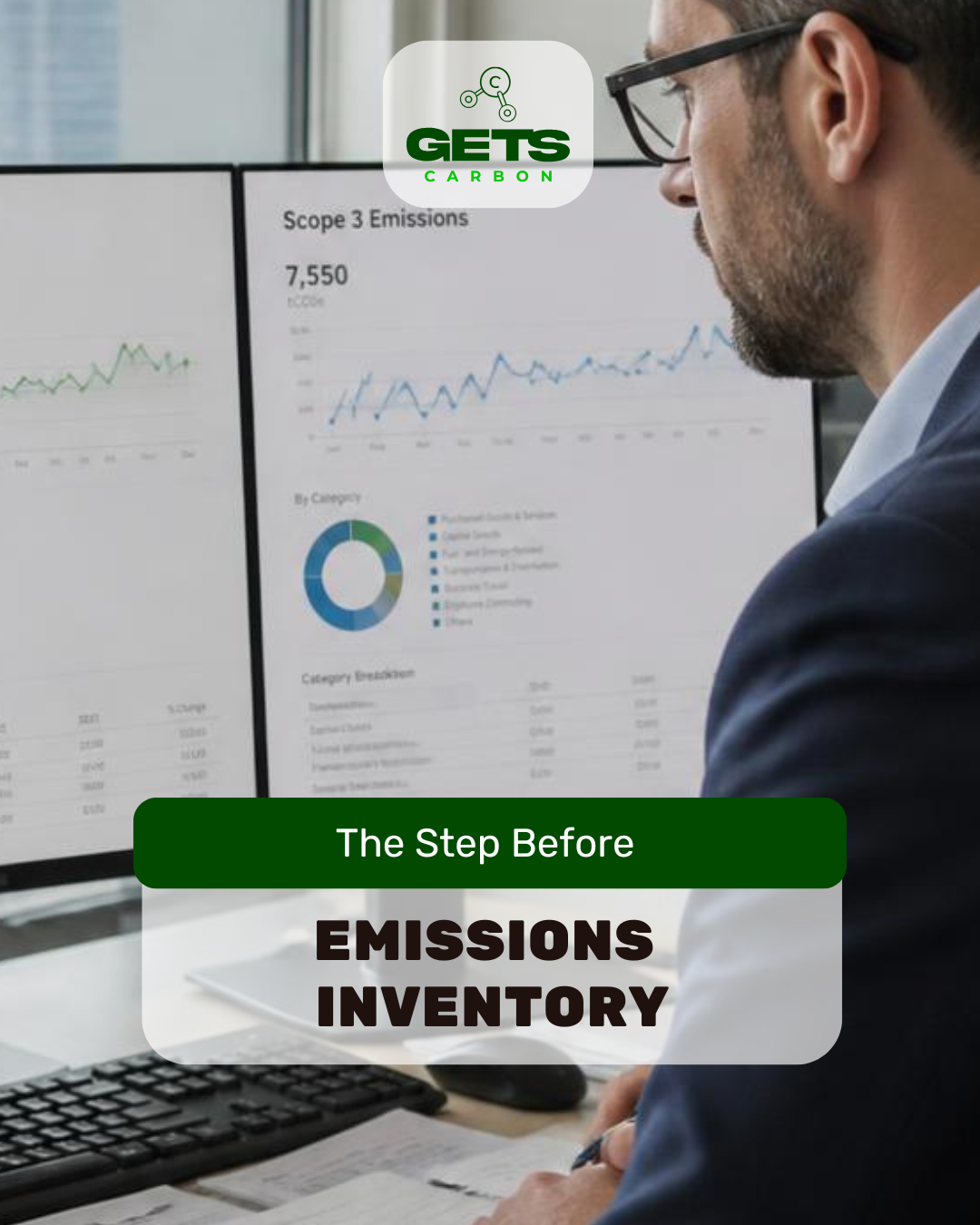
There is a question that should come before any other when a company decides to neutralize its carbon footprint: exactly how much does it emit? It sounds obvious, but most companies that buy carbon credit in Brazil do so based on superficial estimates, without a structured emissions inventory behind them. The result is predictable: offsetting the wrong volume, difficulty proving the purchase to investors or clients, and an ESG strategy that doesn’t hold up under closer audit scrutiny. It’s exactly this first step — the inventory — that underpins the IGEE module within GETS CARBON’s ESG management platform.
The most widely used method globally for structuring this inventory is the GHG Protocol, developed by the World Resources Institute (WRI) in partnership with the World Business Council for Sustainable Development (WBCSD) in the late 1990s. In Brazil, the methodology is applied through the Brazilian GHG Protocol Program, an initiative coordinated by the Center for Sustainability Studies at Fundação Getúlio Vargas (FGVces), in partnership with WRI itself, the Ministry of Environment and Climate Change, the Brazilian Business Council for Sustainable Development (CEBDS), and the WBCSD.
The GHG Protocol organizes a company’s emissions into three scopes. Scope 1 covers direct emissions, generated by sources controlled by the organization itself — such as the company’s vehicle fleet or internal industrial processes. Scope 2 covers indirect emissions associated with purchased electric or thermal energy consumed by the company. Scope 3, generally the most challenging to measure, covers the remaining indirect emissions in the value chain — suppliers, outsourced transportation, corporate travel, and waste disposal, among others. In Brazil, reporting Scope 3 is optional: an inventory without this layer is still considered complete by the Brazilian GHG Protocol Program, as long as it fully accounts for Scopes 1 and 2.
The program grants three seal categories to inventories published in its Public Emissions Registry: the Bronze seal, for partial inventories; the Silver seal, for complete Scope 1 and 2 inventories without external certification; and the Gold seal, reserved for complete inventories certified by an independent third party — the most robust standard, generally adopted by companies that need to demonstrate rigor to investors, banks, or regulatory bodies. The entire process must follow five fundamental principles defined by the methodology: relevance, completeness, consistency, transparency, and accuracy.
In practice, building this inventory involves identifying the operation’s emission sources, choosing the appropriate calculation approach for each source, collecting activity data (fuel consumption, energy, mileage traveled, among others), applying internationally recognized emission factors to convert this activity into tons of CO2 equivalent, and finally compiling everything at the corporate level. It’s a process that requires disciplined data collection throughout the year — it’s not something that can be resolved retroactively in a few days before an audit or a carbon credit negotiation.
This is where the inventory connects directly to the carbon credit purchase decision. Without precisely knowing how much the company actually emits, any volume of credit purchased is, at best, an educated guess. At worst, it’s an insufficient purchase that leaves the company exposed — both operationally and reputationally — if a client, investor, or regulatory body asks to see the numbers behind the announced offset. This risk tends to grow as the Brazilian Emissions Trading System advances through its implementation phases, since the SBCE’s monitoring phase will require exactly this kind of structured report from regulated operators.
For companies that don’t yet have this process structured internally, the most efficient path is usually to centralize activity data collection on a single platform, rather than relying on parallel spreadsheets maintained by different areas. This reduces rework when compiling the annual inventory and avoids discrepancies between numbers reported by different departments — one of the most common, and most embarrassing, mistakes in ESG audits.
GETS CARBON’s ESG platform IGEE module was created exactly for this stage: structuring your company’s emissions inventory and, from there, precisely sizing the purchase of certified carbon credits. Talk to a GETS CARBON specialist and start with the right first step.