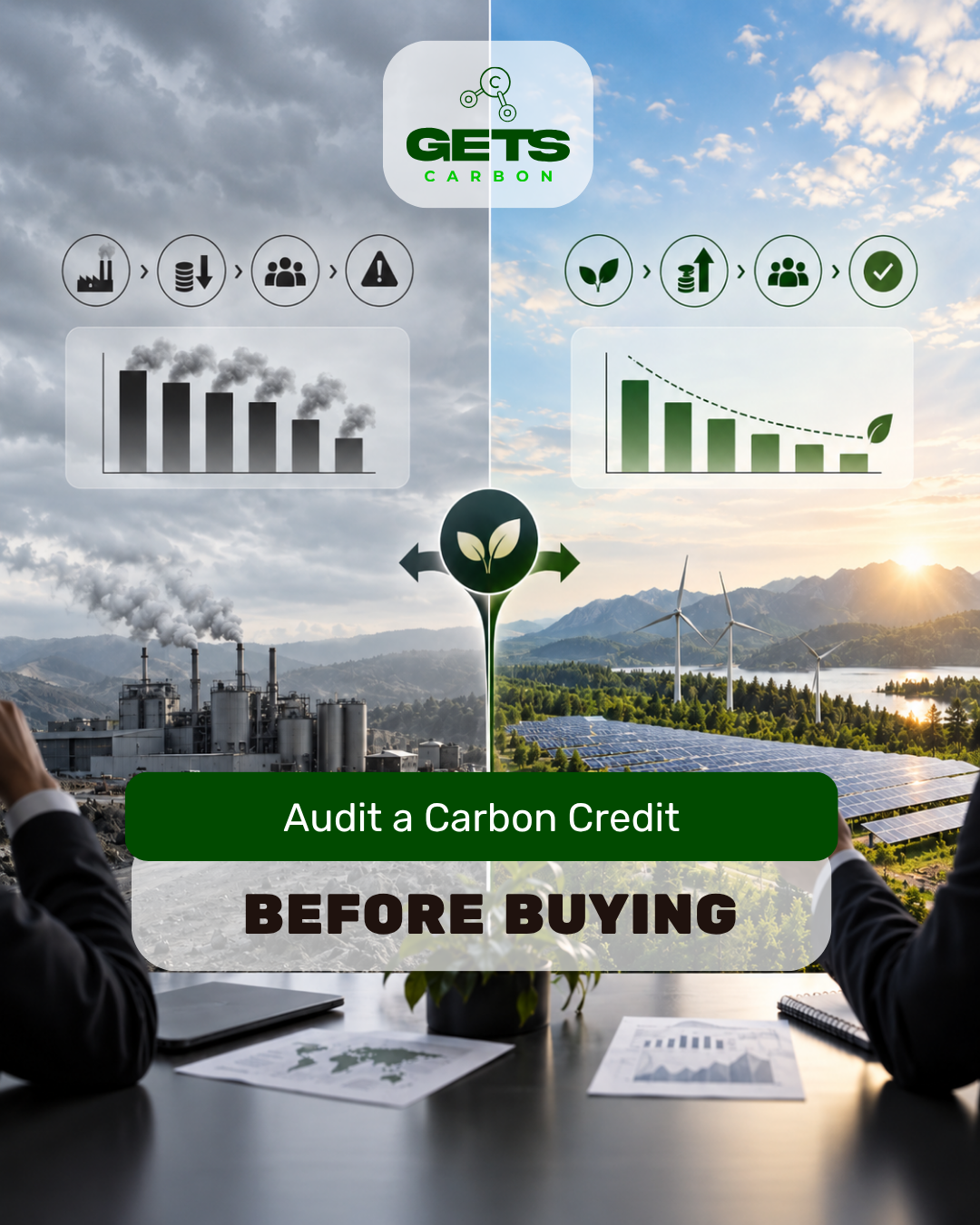
Before signing any purchase agreement, there is a set of information that a serious seller should provide without hesitation: the project identifier in a public registry, the methodology used to calculate the reductions, the credit vintage, the name of the organization that verified the project, and a commitment to retire the credits in your company’s name, with traceable serial numbers. If the seller is evasive about any of these items, the negotiation should stop there. In practice, this is the difference between buying a carbon credit that can withstand an audit and buying a promise that cannot withstand a question.
This concern is not an exaggeration from an overly cautious buyer. The voluntary carbon market has faced international scrutiny in recent years precisely because projects with weak methodologies were sold using the same narrative as solid projects, and because not every buyer knew what questions to ask. The good news is that almost everything that matters can be independently verified: registries are public, methodologies are open documents, and the different types of carbon credits carry distinct risk profiles that can be assessed before the purchase, not afterward.
The first item on the checklist is the simplest and the one that eliminates the most questionable proposals: finding the project in the registry. Credits certified under internationally recognized standards are listed in public registries maintained by the certification bodies themselves, together with project documentation, verification reports, and the issuance and retirement history of each vintage. Ask for the project identifier and check it yourself. A seller that offers a spreadsheet, an attractive presentation, and its own certificate but cannot point to the project in a public registry is selling a document, not an asset.
The second item is the methodology and baseline. Every credit is based on a comparison between what happened and what would have happened without the project, and that comparison is defined by a methodology approved by the certification body. This is where much of the technical risk lies: excessively generous baselines inflate the number of credits generated, and this was precisely the issue that prompted major methodological revisions in recent years, particularly for forest projects involving avoided deforestation. It is worth asking which methodology was used, which version applies, and whether the project has undergone any recent recalibration. Project documents usually address this explicitly.
The third item is additionality, which comes down to the recurring question: would this result have happened even without revenue from the credit? A project that would already have been implemented because of a legal obligation, licensing requirement, or its own economic return tends to face real difficulty proving additionality to a certification body. A buyer that does not ask this question risks paying for a reduction that would have occurred anyway. Additionality is not a philosophical detail of the market; it is what supports the value of the credit as an offset.
The fourth item separates two groups that are often treated as though they were the same: avoidance and removal. A project that prevents an emission from occurring and a project that removes carbon from the atmosphere generate credits with very different risk profiles, particularly when it comes to permanence. Carbon stored in forests can be released back into the atmosphere because of fire, pests, or future deforestation, which is why serious standards require a portion of the credits generated to be retained in a buffer reserve used to cover reversals. Ask how reversal risk has been addressed and what compensation mechanism applies in the event of a loss. A project that has no answer to this question has transferred the risk to the buyer.
The fifth item is the vintage. Older credits generated under outdated versions of methodologies circulate in the market at lower prices precisely because they carry a credibility discount. Buying an older vintage is not automatically wrong, but it needs to be a conscious decision—and one that can be difficult to defend to a customer, investor, or auditor who asks the obvious question of why the company chose the cheapest credit available.
The sixth item is double counting, the most silent risk on the list. The same emissions reduction result cannot be claimed by two parties at the same time—whether by two buyers or simultaneously by the purchasing company and the country where the project is located when that volume is also used to meet national targets. The international framework addressing this problem involves what are known as corresponding adjustments, and the discussion is far from settled. For a corporate buyer, the practical requirement is straightforward: demand a formal declaration explaining how the credit will be accounted for and whether there is any risk that the same volume will be claimed by another party.
The seventh item rarely appears in a spreadsheet, but it is often the one that creates reputational damage: the project’s social safeguards. Projects located in territories occupied by local communities or Indigenous peoples require consultation and benefit-sharing processes, and problems in this area can become news much faster than any discussion about baselines. A project with solid social documentation is also a safer project to associate with your brand.
The eighth item is the use of integrity seals and labels that were created specifically to help buyers filter the market. They are useful and save time, but they do not replace the previous seven items: a label indicates that a type of project complies with a set of principles, not that a specific project is the most appropriate for your company’s profile, purchasing volume, or the narrative you intend to support publicly. A seal is a starting point for screening, not a due diligence report.
The ninth and final item is what completes the transaction: retirement of the credit. A credit only fulfills its role as an offset when it is permanently removed from circulation in the name of the entity that used it, with a public record of that retirement. Until this happens, it remains a tradable asset. A company that has paid for credits but has not required proof of retirement in its own name cannot prove that it has offset anything. Keep this proof with the same care you would give an invoice: it is the evidence supporting any public statement about emissions offsetting.
There is also an important point about the order of these steps. All of this verification loses its purpose if the company still does not know how much it emits and where those emissions occur, because there is no way to determine how much to purchase. Buying the wrong volume is an expensive mistake even when the credit itself is impeccable. The emissions inventory remains the step that should come before any negotiation, and the technical standards applied to this assessment are likely to become more demanding in the coming years as Brazil’s regulated market consolidates its monitoring, reporting, and verification rules.
Conducting this audit internally requires time, the ability to read technical documentation in English, and familiarity with how certification bodies operate. Doing it halfway is the riskiest scenario of all because it creates a sense of security without providing actual security. GETS CARBON evaluates the documentation for each project with you before the purchase, so your company knows exactly what it is buying and can prove it afterward. Talk to a GETS CARBON specialist and submit the proposal currently on your desk for technical analysis before signing.