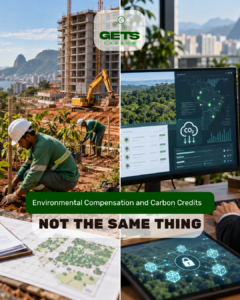
If your company still treats the carbon market as synonymous with the voluntary purchase of credits, a new regulatory chapter is already taking shape—and it changes that equation. Law No. 15,042/2024 established the Brazilian Greenhouse Gas Emissions Trading System (SBCE) and created the legal foundation for a regulated carbon market in Brazil, inspired by the international cap-and-trade model. Instead of each company independently deciding whether to offset its emissions, entire sectors of the economy will operate under an emissions cap, converted into tradable allowances among regulated companies themselves—the so-called Brazilian Emissions Allowances (CBEs).
The logic is straightforward, even if implementation is complex: the government sets an emissions cap for regulated sectors and distributes or auctions allowances within that limit. Companies that emit less than their allowance can sell the surplus, while those that emit more must purchase additional allowances or use offset mechanisms. This is very different from the voluntary carbon market, where purchasing carbon credits is a strategic choice made by the company—and, for businesses already operating in this market today, the process normally begins with a well-structured emissions inventory before any purchasing decision is made.
The governance of the SBCE is already moving forward. The Extraordinary Secretariat for the Carbon Market (SEMC) serves as the system’s managing body, with support from the Interministerial Committee on Climate Change (CIM). In March 2026, the Permanent Technical Advisory Committee (CTCP)—created to provide technical support to the SEMC and CIM—held its inaugural meeting. In May 2026, it published a package of four resolutions organizing its internal operations and creating the first working groups: one focused on financial aspects and market infrastructure, another on emissions monitoring, reporting, and verification (MRV), and another on accrediting the methodologies that will generate verified emissions reduction or removal certificates (CRVEs).
One of these groups deserves particular attention from companies that already purchase carbon credits today: the methodologies group, which is responsible for defining the baseline, additionality, and permanence criteria that will validate each certificate generated within the regulated system. In practice, the SBCE is not only creating a new market—it is also establishing a standard of technical rigor that is likely to become a reference even for companies that continue operating in the voluntary market, raising expectations regarding the quality of carbon credits offered in Brazil.
Alongside the resolutions, the SEMC presented the CTCP with a preliminary proposal for sectoral coverage—that is, which sectors of the economy will be the first required to monitor, report, and verify their emissions. The proposal establishes implementation in three waves: starting in 2027, pulp and paper, iron and steel, cement, primary aluminum, oil and gas exploration and production, refining, and air transport would be included; starting in 2029, mining, recycled aluminum, the power sector, glass, food and beverages, chemicals, ceramics, and waste would follow; and starting in 2031, road, waterway, and rail transport would be included.
According to the proposal, each included sector would have a four-year preparatory period before assuming full obligations. In the first year, the company prepares its monitoring plan; in the second and third years, it effectively monitors its emissions; and in the fourth, it participates in the development of the National Allocation Plan, which will define how allowances are distributed. During this preparatory period, obligations are limited to monitoring and reporting. The periodic reconciliation required under the SBCE Law—when a company must effectively demonstrate that it has covered its emissions with allowances or credits—only begins afterward.
Looking at the full timeline, the goal is to complete the first phase of secondary regulations by December 2026, with emissions reporting beginning in 2027, implementation continuing through 2028 and 2029, and the full trading phase—with the emissions cap and National Allocation Plan defined—expected in 2030, followed by full consolidation in 2031. It is a long timeline, but it is not hypothetical: the law already exists, the governance structure is already operating, and there is already a concrete proposal identifying which sectors will enter first.
For companies that currently participate only in the voluntary market—purchasing credits to offset emissions by choice, without a legal obligation—the SBCE is not an immediate threat, but it is a clear signal of where the Brazilian market is heading. The two markets will coexist: the regulated market, mandatory for the listed sectors, and the voluntary market, open to any company that wants to get ahead. Companies that begin organizing their emissions data now, even if they are not among the sectors in the first wave, will be better prepared when sectoral coverage expands—and this is exactly the kind of continuous preparation that a structured ESG management platform enables, rather than leaving everything until the four-year preparatory period begins.
The first practical step is the same whether your company is in a regulated sector or not: know exactly how much you emit and where those emissions come from. GETS CARBON helps your company interpret what the SBCE means for your sector and structure, from now on, the data that will support any carbon strategy going forward. Talk to a GETS CARBON specialist and understand what is changing for your business.