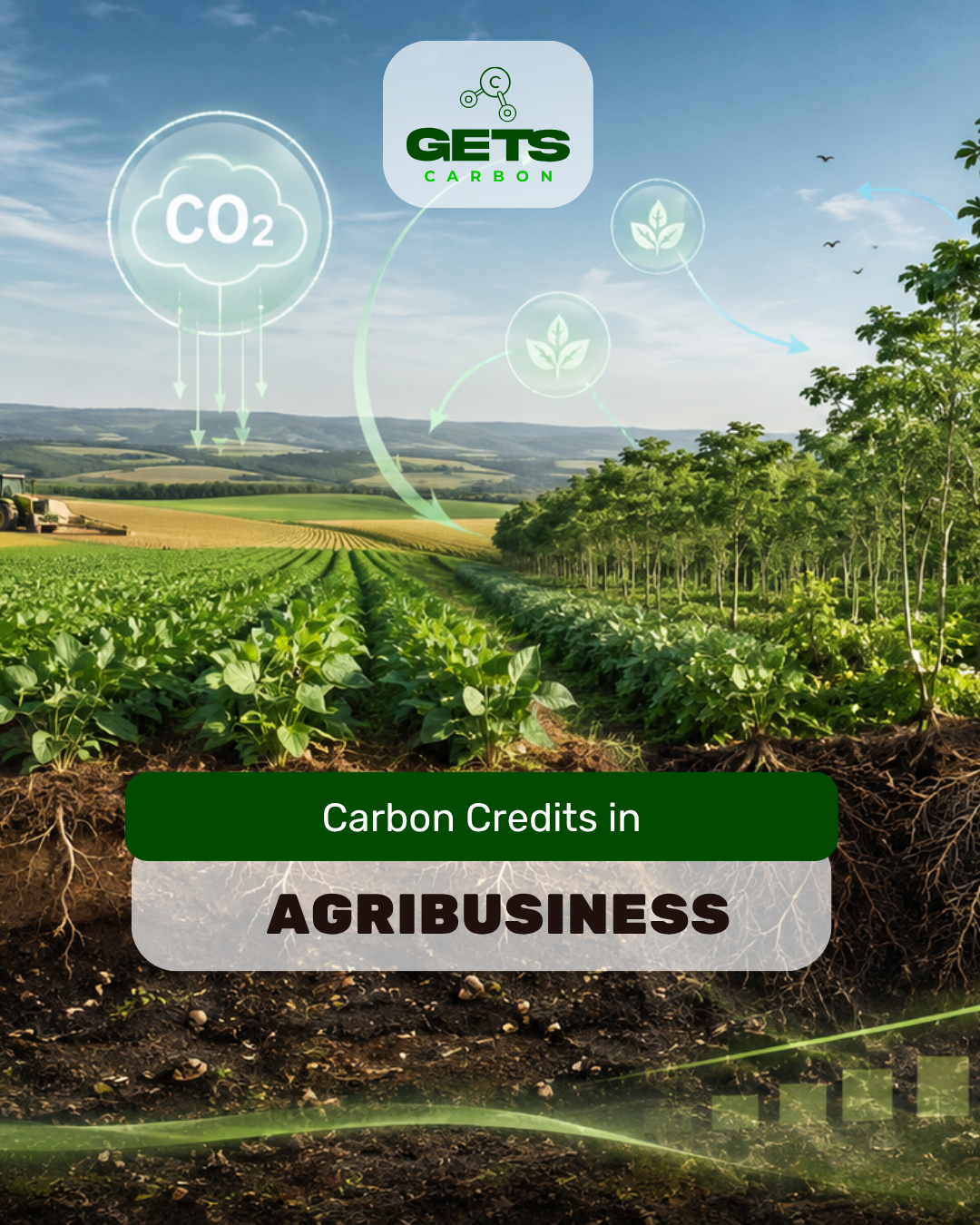
Brazil holds 40% of the world’s tropical forests, according to FAO data cited on GETS CARBON’s own carbon market page, yet most rural producers still see carbon credits as something related to industry or large corporations—not as a source of revenue that can exist within the farm itself. That view is outdated. Among the most direct applications of carbon credits is agribusiness itself, supported by reforestation projects, soil carbon capture, and low-emission agricultural techniques.
The best-known mechanism is reforestation: degraded or low-productivity areas restored with native species or sustainable forest management can generate certifiable carbon credits, as growing vegetation captures CO₂ from the atmosphere. But reforestation is not the only path. Soil management—practices such as no-till farming, crop-livestock-forest integration, and crop rotation that increase organic carbon stocks in the soil—is also recognized as a source of credits under international methodologies, with the advantage of being applicable within the productive area itself, without requiring the land to be taken out of production.
One criterion that often causes agricultural carbon projects to fail even before certification is additionality—the requirement to prove that the carbon capture would not happen anyway as part of the property’s normal management. Reforestation in an area that would already have to be restored to comply with environmental licensing requirements, for example, tends to face difficulty proving additionality before an international certifier. For this reason, planning a carbon project with technical support from the beginning, rather than only after restoration is already underway, makes a real difference between an approved credit and a project rejected during the audit.
Brazil’s potential in this market is still far from being fully explored. According to the same GETS CARBON carbon market page, the country currently has approximately 5 million credits in circulation in the voluntary market, but its estimated potential reaches as much as 26 billion credits per year—a gap that shows how much of Brazilian agribusiness’s credit-generation capacity, especially linked to forests and soil, has not yet been converted into real income for producers. Projections also indicate that Brazil could supply 48.7% of global demand for carbon credits by 2030, and agribusiness is the country’s best-positioned economic activity to capture that demand precisely because it holds most of the forest and agricultural base that supports this type of project.
As with any carbon strategy, the starting point is not to begin selling hectares of forest as credits—it is to understand accurately which part of the property already sequesters carbon, which part can be restored, and which part of the operation still generates net emissions that need to be offset. A well-structured emissions inventory, adapted to the reality of a rural property or agribusiness operation, is what distinguishes a commercially viable carbon project from an optimistic estimate that does not withstand the audit of an international certifier.
GETS AMBIENTAL has long worked with flora assessments, degraded area recovery plans, and environmental monitoring—exactly the type of technical fieldwork that supports a forest or soil-management carbon credit project before it actually becomes certified and saleable. It is this technical field foundation, combined with the structuring of the credit itself, that distinguishes a rigorously conducted project from a generic promise to “monetize sustainability”—a message that already circulates widely in the sector without the corresponding technical backing.
For producers or agribusiness companies that already apply more responsible management practices but have never formalized them as a carbon project, the first step is simple to describe and demanding to execute well: map the property, quantify what is already capturing carbon and what is still emitting, and assess with a recognized certifier whether the volume and methodology justify the certification process. GETS CARBON helps your property or agribusiness evaluate that potential with technical rigor, from measurement to certification. Talk to a GETS CARBON specialist and find out whether your operation is already ready to generate carbon credits.