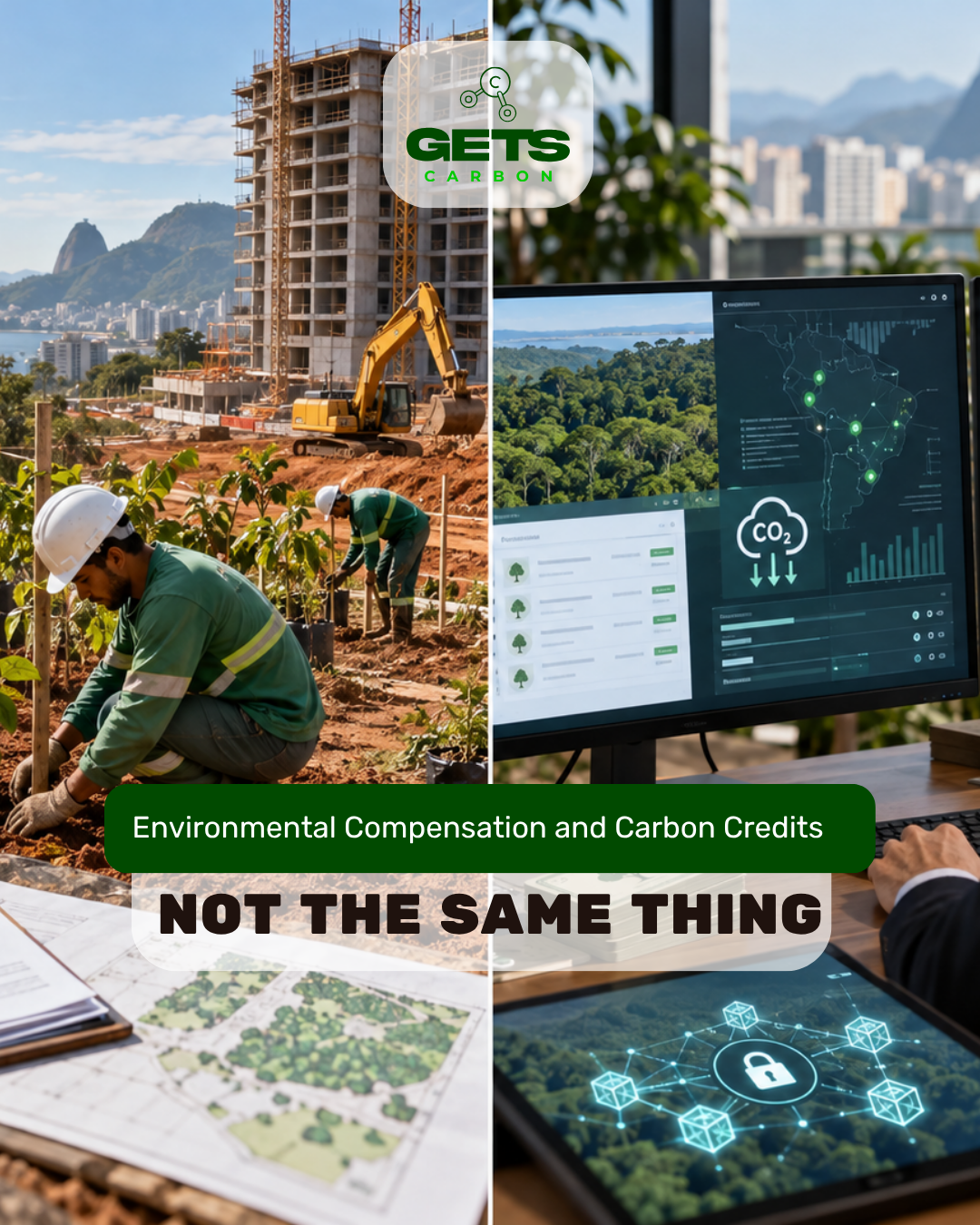
A real estate developer that removed trees to make a project viable, signed the planting commitment required by the environmental authority, and fully complied with that planting obligation did exactly what the law required — and, in doing so, did not generate a single carbon credit. These are two instruments with completely different legal natures, units of measurement, and purposes. Treating them as equivalent is one of the most common mistakes in the construction and real estate development sector, with consequences ranging from misleading market communication to poor investment decisions — including hiring carbon credit services in the expectation that they will satisfy an obligation imposed by an environmental license, when they do not.
Environmental compensation originates within the licensing process: it is an obligation to act, imposed as a condition for the project to move forward. It may take different forms depending on the biome, the scale of the impact, and the municipality — compensatory planting linked to a commitment agreement signed with the environmental authority, restoration of an equivalent area, or support for conservation units. The unit may be trees, hectares, or monetary value; the counterpart is the right to carry out the project; and the result is not an asset. It cannot be sold, transferred, or accounted for in tonnes of carbon dioxide equivalent. Rules vary considerably between states and municipalities, and the specific requirements depend on the licensing process for each project. For that reason, the structure must be confirmed on a case-by-case basis with the professionals responsible for the licensing process rather than assumed based on previous experience in another city. None of this should be confused with the logic of the carbon market, which measures something different, follows a different set of rules, and produces a different type of outcome.
A carbon credit follows an entirely different logic. It is an asset certified under an internationally recognized standard, measured in tonnes of carbon dioxide equivalent, verified by an independent body, publicly registered, and transferable until it is retired in the name of the entity using it. Among the sector-specific applications of the instrument, construction and real estate are particularly relevant because the sector accounts for significant emissions. However, generating or purchasing credits is a voluntary climate strategy decision, not the fulfillment of a licensing condition.
Confusing the two instruments can be costly in three distinct ways. The first is communication: presenting a development as carbon neutral because compensatory planting requirements were fulfilled is a claim that is not technically supported and, increasingly, may not be legally sustainable either. Rules governing environmental advertising claims have become stricter in Brazil and abroad, and environmental claims without measurable substantiation have become a concrete risk rather than a minor marketing issue. The second is technical: planting carried out because of a legal requirement would be unlikely to demonstrate additionality to a certification body because it would have happened anyway — meaning that the same area cannot simply become a tradable carbon credit. The third is financial: investors, lenders, and corporate clients requesting climate data do not accept a licensing condition as an answer because that is not what they need to report.
Where, then, is the actual carbon footprint of a construction project? A significant share is found in materials. Cement, steel, and aluminum account for a substantial portion of a project’s footprint, and these emissions occur before construction begins, during the production of those materials. For a developer, these are typically value-chain emissions, classified in the emissions inventory outside the company’s direct operations — which often creates the misleading impression that they are not the developer’s problem. They are, for a very practical reason: the cement, iron, and steel sectors are among the first expected to enter Brazil’s emissions trading system, with monitoring and reporting obligations scheduled to begin from 2027. When the cost of carbon becomes part of the material’s pricing structure, it reaches the construction budget on its own, regardless of whether the developer has adopted a climate strategy.
This changes the nature of the discussion. It stops being primarily a matter of institutional image and becomes an issue of cost predictability and access to capital — a language the sector understands very well. A construction company that knows how much carbon is embedded in each project typology can compare suppliers, test alternative specifications, estimate the impact of future increases in material costs, and respond with data when a lender asks for it. A company without an emissions inventory simply cannot make those same moves with the same level of information.
The practical path follows an order that is rarely respected. First, measure: prepare an emissions inventory that separates direct consumption at the construction site, purchased energy, and emissions from materials and the supplier chain. Second, reduce emissions wherever reductions are possible — through material specifications, site efficiency, logistics, and waste management. Third, and only then, compensate for the remaining emissions with certified carbon credits, treating the purchase as the final step of a strategy rather than a shortcut around the first one. In parallel with all of this, the company must still fulfill the environmental compensation required by the license, which remains an independent obligation and does not replace any of those three stages.
Construction and real estate development companies already deal with environmental licensing, flora assessments, tree management authorizations, and waste management plans. Much of the technical data required for a greenhouse gas inventory has already been collected at some point through these processes — but organized for another purpose and then archived. GETS CARBON is an extension of GETS AMBIENTAL, created specifically to meet demand related to carbon credits, and this is precisely the bridge that the structure of the two operations makes possible: using the data discipline the sector already applies for licensing purposes and transforming it into a measurable carbon strategy instead of starting from scratch. Understanding how the two operations complement each other helps explain why this integration can shorten the path, as described on the company’s carbon market page.
If your project has an environmental compensation obligation, a climate target to communicate, or both, the first step is to clearly separate what belongs to the licensing obligation from what belongs to the carbon strategy — and to measure before making any promises to the market. Speak with a GETS CARBON specialist and understand what your project actually emits before announcing what it offsets.