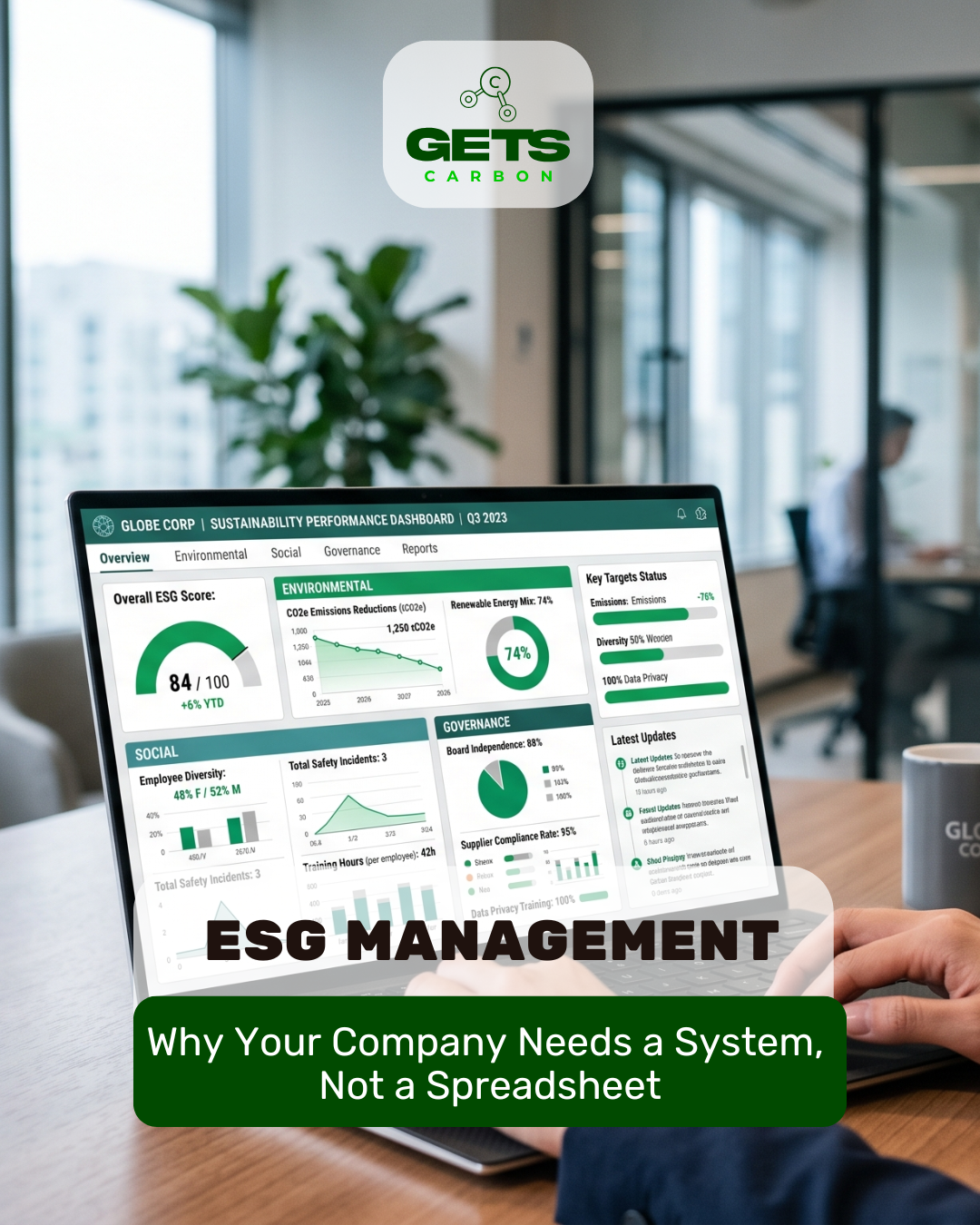
Every company that starts looking at corporate sustainability goes through the same pain point: ESG data scattered across spreadsheets, supplier PDFs, emails, and project folders that never talk to each other. This makes it nearly impossible to confidently answer a simple question from an investor or auditor: “what is your company’s real ESG maturity today?” That is exactly the problem GETS CARBON’s ESG management platform was built to solve, and that’s why treating ESG as a spreadsheet project, in 2026, already means operating at a disadvantage.
GETS CARBON is an extension of GETS AMBIENTAL, created specifically to meet the demand for carbon credit and, more recently, for structured ESG management. Not by chance: buying carbon credit without ESG governance behind it is like buying insurance without knowing exactly what’s being protected. Emissions offsetting only makes strategic sense when it’s tied to indicators, goals, and organized evidence — and that’s where most Brazilian companies, especially mid-sized ones, still fall short.
GETS CARBON’s ESG platform was structured based on recognized technical references, such as ABNT PR 2030, ISO standards, and international sustainability frameworks. In practice, this means the company can centralize environmental, social, and governance evidence in a single environment, instead of relying on a shared folder that only one team member knows how to find. The workflow follows a four-step logic: centralized document upload, artificial intelligence analysis, ESG maturity assessment, and executive dashboard visualization.
One of the platform’s most relevant differentiators is the GHG Inventory module (IGEE — Inventário de Gases de Efeito Estufa), developed in compliance with the GHG Protocol Brazil. This directly connects ESG management to the first step any company needs to take before even thinking about buying carbon credit: understanding and quantifying its own emissions. Without this diagnosis, any offsetting strategy risks buying the wrong amount of credit, or investing in an ESG narrative that doesn’t hold up under closer audit scrutiny.
The platform is also equipped to support the generation of sustainability reports aligned with the GRI Standards, one of the most widely used international frameworks globally for environmental, social, and governance reporting. This is particularly relevant at a time when the Brazilian regulatory landscape is shifting: disclosure of sustainability financial reports has moved from being a future obligation for publicly traded companies to a strategic choice — reporting, and reporting well, is no longer just bureaucratic compliance.
This doesn’t mean structured ESG is only for large publicly listed corporations. Mid-sized companies that supply large corporations, compete for public bids, or seek cheaper bank credit already feel the pressure for organized ESG evidence — except that, without a system, they respond to that pressure with manual work, under deadline pressure, always reactively. A centralized platform flips that logic: the company already has the data ready when the question arrives.
It’s worth noting that the platform was designed to evolve alongside the company’s ESG maturity. This means an organization can start simply by organizing documents and evidence by pillar (environmental, social, and governance) and, as management advances, activate more advanced modules, such as the IGEE itself or structured GRI report generation. This modular logic avoids the common mistake of companies trying to implement a complete ESG management system all at once, getting stuck midway, and going back to the spreadsheet for lack of internal stamina.
It’s also worth noting that the platform was designed for multi-departmental operations — meaning different areas of the company (sustainability, legal, HR, operations) feed the same system, instead of each department maintaining its own isolated version of the ESG truth. This reduces one of the biggest reputational risks in audits: discovering, in the middle of an external verification, that two areas of the same company report different numbers for the same indicator.
If your company already buys or is evaluating buying carbon credit, it’s worth a simple exercise: before closing the next purchase, ask internally whether there is an updated, documented emissions inventory behind that decision. If the answer is no, the problem isn’t the carbon credit — it’s the absence of an ESG management system that backs that decision with real data.
GETS CARBON structures this journey end to end: from organizing ESG management to purchasing certified, traceable carbon credits. Talk to a GETS CARBON specialist and assess your company’s ESG maturity level.