Between 2027 and 2031, seven groups of Brazilian industrial sectors will become legally required to monitor, report, and verify their emissions under the SBCE—and iron and steel, cement, pulp and paper, and chemicals are among the first sectors to enter the system, starting in 2027. For companies that until now have viewed carbon credits primarily as a voluntary reputational initiative, this confirms that, in heavy industry, carbon management is shifting from an optional measure to a compliance variable. The path to preparation, however, remains the same whether a company is currently covered by regulation or not: understand where its emissions come from and determine how they can be reduced or offset using certified carbon credits.
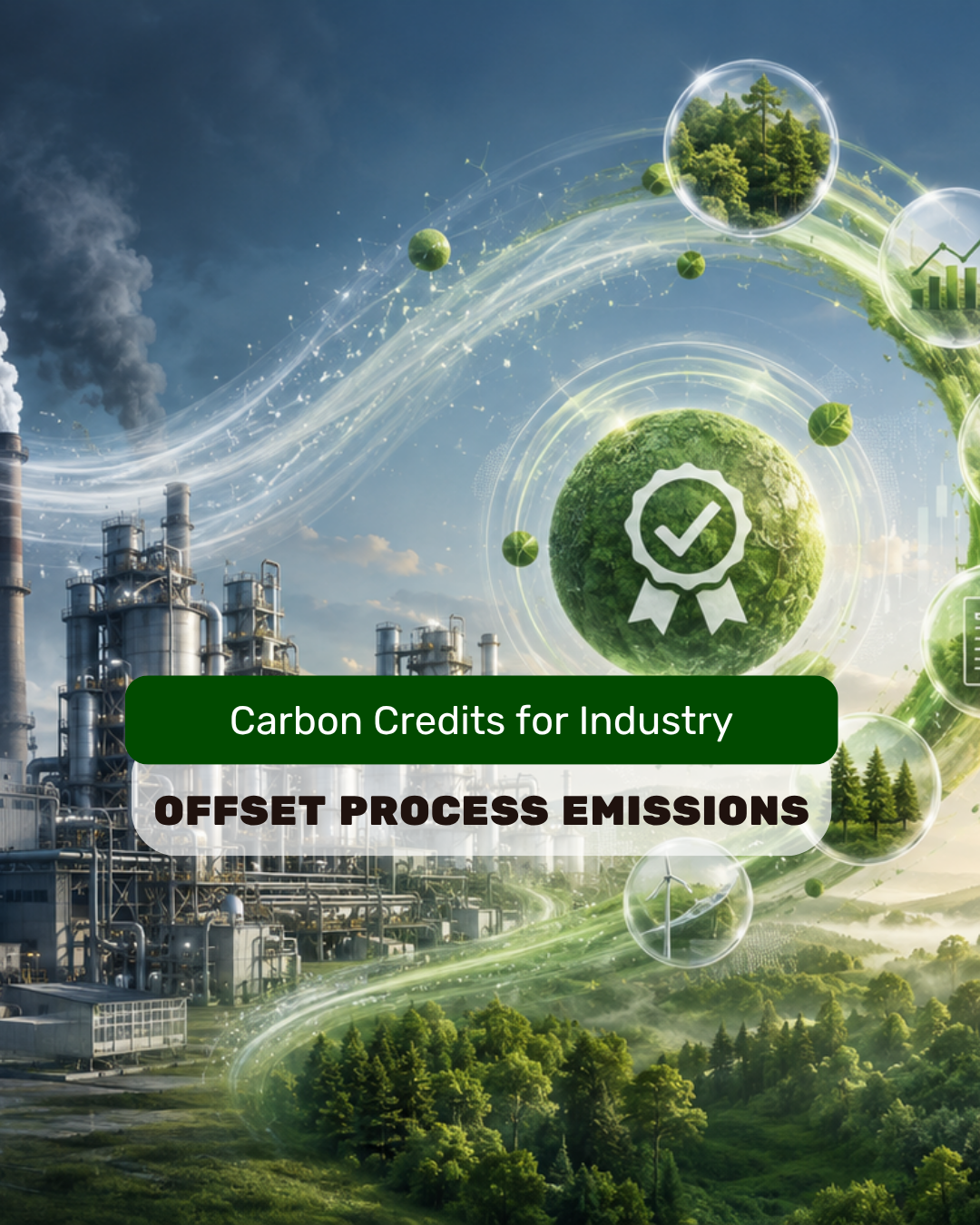
The reason steelmakers, cement manufacturers, and chemical companies are consistently among the first sectors discussed in relation to the carbon market, both in Brazil and internationally, is that a significant share of their emissions does not come solely from the energy they consume—it comes from the chemical reactions inherent to their production processes. In cement production, limestone calcination releases CO₂ as an unavoidable part of its transformation into clinker, regardless of the energy source used in the kiln. In steelmaking, the reduction of iron ore has traditionally relied on carbon as a reducing agent. These are known as process emissions, among the applications where carbon credits can have a direct impact—and they cannot be eliminated through energy efficiency or changes to the electricity mix alone because they are part of the chemistry of production itself.
This is precisely why offsetting through carbon credits occupies a space that direct emissions reductions alone cannot always cover. An industrial company can invest heavily in energy efficiency, carbon capture, or alternative raw materials and still be left with a portion of residual emissions that is inherent to its production process. It is this remaining portion that can make sense to offset with certified credits, rather than treating the purchase of carbon credits as a substitute for internal emissions-reduction efforts.
Before making any purchase, the starting point is the same as it is for any sector: an emissions inventory that clearly separates process emissions (Scope 1), emissions from purchased energy (Scope 2), and emissions associated with suppliers and logistics throughout the value chain (Scope 3). For industrial companies, this distinction is even more important than it is for service businesses because process emissions tend to represent a significantly larger share of the total footprint. Purchasing credits without knowing exactly which emissions can be reduced and which are structurally unavoidable is, in practice, an educated guess about how many credits the company actually needs.
Industrial companies that already deal with environmental licensing, technical reports, and compliance audits—as is the case for a significant portion of GETS AMBIENTAL’s client portfolio—already have some of the data discipline required for a carbon strategy: process histories, atmospheric emissions records, and audit reports. The difference is that these data are typically organized only for licensing purposes and are not reused to build a greenhouse gas inventory or determine the appropriate volume of carbon credits to purchase. It is precisely this bridge—between the environmental compliance that industry already practices and the carbon strategy it has yet to structure—that connects the work of GETS AMBIENTAL with GETS CARBON and the broader carbon market.
It is also important to emphasize that the SBCE timeline provides each regulated sector with a four-year preparatory period before any full reconciliation obligation takes effect. This gives companies enough time to structure their emissions inventories, assess credit suppliers, and understand the most appropriate portfolio profile—provided they begin organizing this work now rather than waiting until the final year of the preparation period. Industrial companies that postpone this process may find themselves racing against the clock precisely when demand for certified carbon credits is expected to increase among peers in the same sector, putting additional pressure on price and availability across the carbon market.
If your industrial company is among the sectors entering the SBCE from 2027 onward, or if it simply recognizes that a significant share of its emissions comes directly from its production processes, the time to structure a carbon strategy is before it becomes an obligation. GETS CARBON helps industrial companies understand exactly which portion of their emissions can be reduced and which portion may be appropriate to offset using certified carbon credits. Talk to a GETS CARBON specialist and assess the emissions profile of your production process.